Singapore’s workplace safety and health obligations are governed by the Workplace Safety and Health (WSH) Act, which came into force in 2006. The WSH Act is administered and enforced by the Workplace Safety and Health Council (WSHC) and the Ministry of Manpower (MOM).
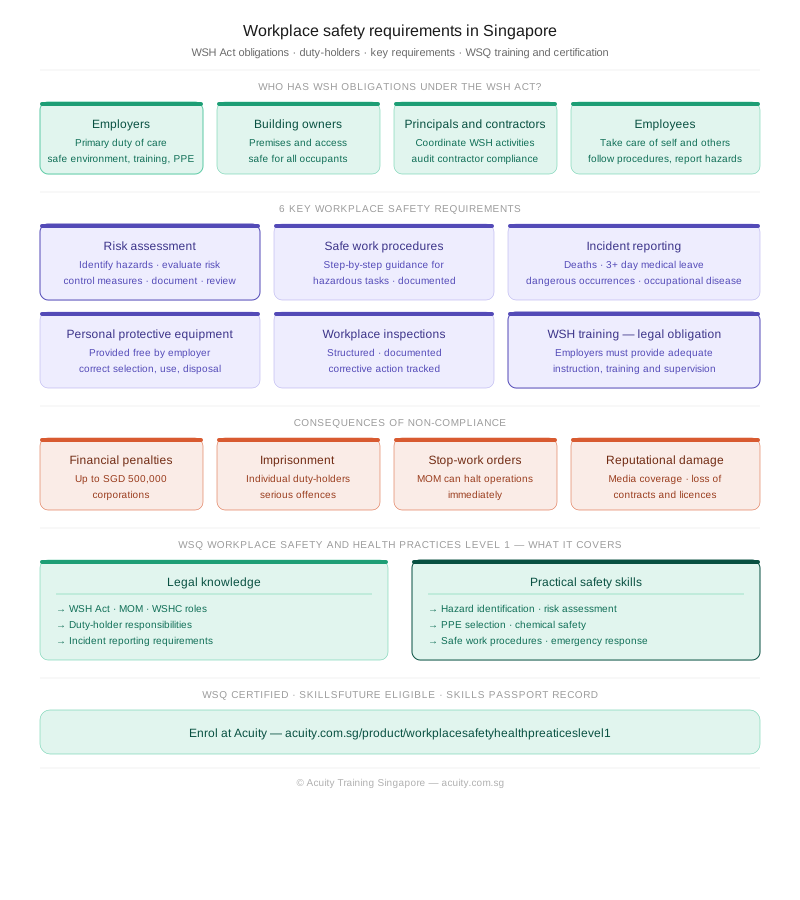
Under Singapore’s risk-based WSH framework, duty-holders — including employers, building owners, principals, contractors, and employees — are required to take all reasonably practicable measures to ensure workplace safety. Those who create the risk are responsible for managing it.
Singapore’s WSH framework applies to virtually all workplaces in Singapore — though specific obligations vary by industry, workplace type, and role.
Employers bear the primary duty of care under the WSH Act. Their obligations include:
Building owners must ensure that the premises, means of access, and any equipment or facilities provided for common use are designed, constructed, and maintained to be safe — and that the building does not create WSH risks for occupants, workers, or the public.
Principals — organisations that engage contractors to carry out work — must:
Under the WSH Act, employees must:
Risk assessment is the cornerstone of Singapore’s WSH compliance framework. Under the WSH (Risk Management) Regulations, employers must:
Employers must establish documented safe work procedures for hazardous tasks. These must provide step-by-step guidance on carrying out tasks safely, identify hazards and risks at each step, specify control measures and PPE required, and define emergency procedures.
Under the WSH Act, employers must report specified workplace accidents and dangerous occurrences to MOM within defined timeframes. Reportable incidents include:
Employers must provide appropriate PPE at no cost to employees. Key PPE categories relevant across Singapore’s built environment and service sectors include:
Regular workplace inspections identify hazards, assess the effectiveness of existing controls, and confirm safe work procedures are being followed. Effective inspections follow structured checklists, involve workers, generate documented findings, and drive corrective action.
Employers have a legal obligation under the WSH Act to provide adequate information, instruction, training, and supervision. Formal WSQ WSH training — such as Workplace Safety and Health Practices Level 1 — develops the knowledge and practical skills that employees need to understand and apply WSH requirements in their specific workplace context.
Cleaning and FM professionals work with chemical cleaning agents, mechanical equipment, biological contaminants, and wet floor environments. Key requirements include risk assessments and safe work procedures for chemical handling, correct PPE selection and use, safe handling and storage of cleaning chemicals, wet floor management, manual handling awareness, and incident reporting.
F&B and institutional food service environments combine WSH risks from heat, chemical cleaning agents, sharp implements, wet floors, and food safety hazards. Combining Workplace Safety and Health Practices Level 1 with WSQ Food Safety Level 1 provides the complementary compliance credentials these environments require.
Security officers work in environments with specific WSH risks — lone working, shift work, physical confrontation risks, and outdoor exposure. Security professionals should combine their licensing training — such as the Security Officer BLU Course — with WSH competency development for a complete compliance profile.
Under the WSH Act, individuals and corporations found guilty of WSH offences face substantial financial penalties — up to SGD 500,000 for corporations and SGD 200,000 for individuals for offences causing death. General WSH offences carry fines of up to SGD 50,000 for individuals and SGD 200,000 for corporations.
Individual duty-holders found guilty of serious WSH offences can face imprisonment as well as financial penalties. For offences causing death through negligence, imprisonment of up to two years (first offence) is possible.
MOM inspectors have the power to issue Stop-Work Orders requiring all or part of a work operation to cease immediately where they identify an imminent risk to workplace safety.
Workplace safety incidents — particularly serious injuries and fatalities — have significant reputational consequences. They are frequently covered in the media and may disqualify organisations from government procurement and licencing processes.
Acuity’s Workplace Safety and Health Practices Level 1 course is a WSQ-aligned programme that develops practical workplace safety competency for workers across Singapore’s service industries.
Candidates who meet the required standard receive a WSQ certificate confirming their Workplace Safety and Health Practices Level 1 competency. This certificate is recorded on their SkillsFuture Skills Passport and demonstrates to employers and regulators that the holder has received formal, assessed WSH training.
The WSH Act requires employers to provide adequate information, instruction, training, and supervision to all employees. Employers who fail to provide adequate WSH training and whose workers suffer injury as a result are likely to be found in breach of their WSH duties. Formal WSQ training is the most defensible way to demonstrate that adequate training has been provided.
Employers face financial penalties, potential imprisonment for serious offences, stop-work orders, and reputational damage. Severity escalates with the seriousness of the breach and whether it caused injury or death. MOM publishes enforcement outcomes and penalties for serious breaches are typically media-covered.
Workplace safety requirements are enforced by the Ministry of Manpower (MOM), which conducts workplace inspections, investigates incidents, and takes enforcement action. The Workplace Safety and Health Council (WSHC) supports compliance through guidance and standards.
A risk assessment is a systematic process for identifying workplace hazards, evaluating the risks they create, and implementing appropriate control measures. It is required under the WSH (Risk Management) Regulations for all workplaces in Singapore and must be documented, communicated to workers, and reviewed regularly.
The WSQ Workplace Safety and Health Practices Level 1 course provides formal, nationally assessed training covering Singapore’s WSH legal requirements, hazard identification, risk assessment, safe work procedures, PPE, chemical safety, and incident reporting — supporting the employer’s duty to provide adequate instruction under the WSH Act.
Please fill in the following details so we can assist you better.
This will close in 0 seconds