

Singapore is a uniquely advantageous place to learn Chinese. With Mandarin as one of the country’s four official languages, learners have immediate opportunities to practise in everyday life — at hawker centres, in the workplace, with neighbours, and in social settings.
Beyond the local environment, there are strong professional and personal reasons to learn Chinese:
Whether your motivation is professional, cultural, or personal, starting a Chinese course in Singapore gives you immediate access to a living language environment that accelerates learning naturally.
A beginner Chinese course is designed for learners with little to no prior knowledge of the language. A well-structured programme will build your foundation progressively across speaking, listening, reading, and writing.
Mandarin is a tonal language — the same syllable can have four different meanings depending on the tone used. This is the most critical skill for beginners to develop early, as incorrect tones can change your meaning entirely. Beginner courses focus on:
Building a core vocabulary is essential for functional communication. Beginner courses typically introduce vocabulary in thematic categories such as numbers, colours, food, family, time, directions, and daily routines.
Mandarin grammar is structurally different from English — there are no verb conjugations, no plural forms, and sentence structure follows its own logic. Beginners learn:
While not all beginner courses cover written characters in depth, a good programme will introduce simplified Chinese characters alongside Pinyin so learners can begin to recognise common words in written form.
The best beginner courses build in structured speaking practice from the very first lesson. Real-world scenarios — ordering food, asking for directions, making introductions, shopping — give learners the confidence to use the language outside the classroom.
Singapore has a rich linguistic landscape that includes not just Mandarin but also dialects such as Hokkien, Cantonese, Teochew, and Hakka. If you are starting from scratch, this question often comes up.
For most beginners — especially those motivated by professional or travel goals — Mandarin is the right starting point. It is the official written and spoken standard across Singapore, China, and Taiwan; the most widely taught and tested form of Chinese; and the version used in business, education, and formal settings across Asia.
If your motivation is to communicate with older family members, connect with a specific heritage community, or explore Singapore’s rich dialect traditions, a Conversational Chinese and Dialect course may be the right complement or alternative to standard Mandarin.
Acuity offers both Chinese language courses and Conversational Chinese and Dialect programmes — giving learners the flexibility to pursue the variety of Chinese that best fits their goals.
One of the most common questions from beginners is how long it takes to reach a functional level in Mandarin. The honest answer is that it depends on several factors — your starting point, study intensity, and how much you practise outside class. As a general guide for adult beginners:
The key accelerator is daily exposure. In Singapore, this is easier than almost anywhere else — the language is all around you, and every interaction is an opportunity to practise what you have learned in class.
Not all beginner Chinese courses are equal. Here is what to evaluate before enrolling:
Look for a course that assumes zero prior knowledge and builds systematically from pronunciation through vocabulary, grammar, and conversation. Avoid courses that skip Pinyin or jump too quickly into characters before spoken foundations are established.
The quality of your instructor makes an enormous difference at the beginner stage. Look for teachers who are native or near-native Mandarin speakers, have experience teaching Chinese to adult learners, can explain grammar concepts clearly in English, and create a supportive classroom environment.
Speaking practice requires individual attention and correction. Small class sizes allow instructors to give personalised feedback on pronunciation and tones — the area where beginners need the most guided support.
A good beginner course allocates significant class time to speaking and listening — not just vocabulary drills or written exercises. You should be producing Mandarin from lesson one, not waiting until you feel ready.
Adult learners juggle work, family, and other commitments. Look for a provider that offers weekday evening and weekend options so learning fits around your life rather than disrupting it.
The best providers offer a progression pathway — so when you complete the beginner course, you know exactly what comes next and can continue developing without switching providers or starting over.
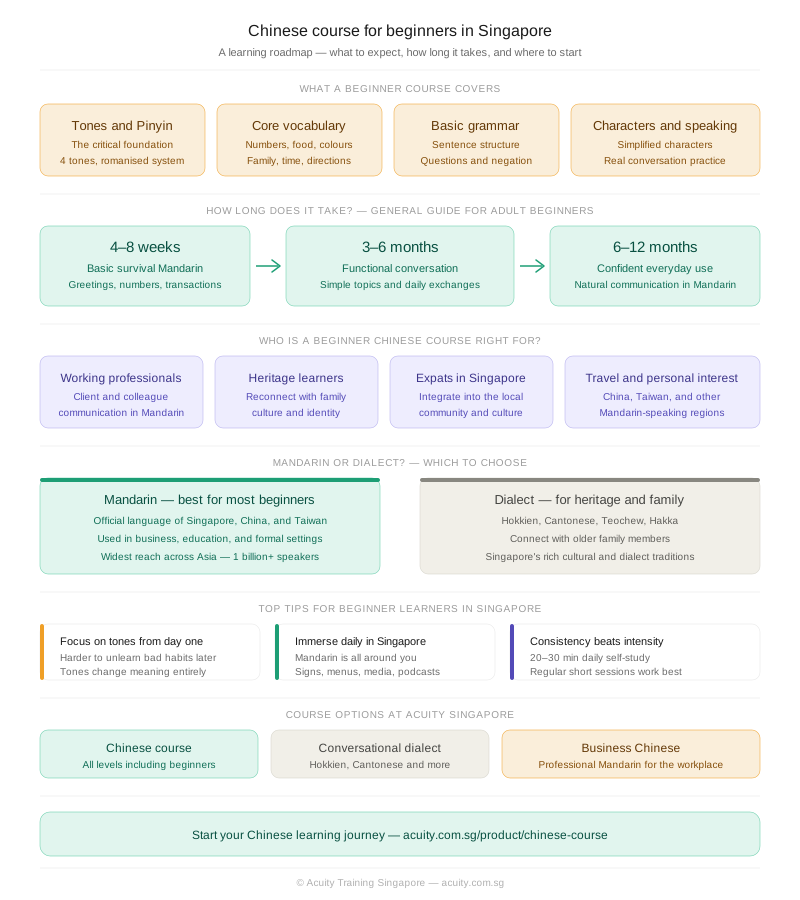
Starting a new language is exciting, but it can also be challenging. Here are practical strategies to support your progress outside the classroom:
Singapore makes this easy. Listen to Mandarin radio or podcasts during your commute. Watch Mandarin-language dramas or news programmes with subtitles. Pay attention to Chinese signage, menus, and packaging around you.
Many beginners underestimate how important tones are and pay the price later. Make correct tone production a priority from your very first lesson — it is much harder to unlearn bad habits than to build good ones from the start.
Spend 10 to 15 minutes each day reviewing new vocabulary — flashcard apps, handwritten notes, or labelling objects around your home all work well. Consistency compounds over time.
Silent reading and passive listening are useful but insufficient. Speak aloud as much as possible — even if you are alone, practise your tones, repeat dialogues from class, and narrate your daily activities in Mandarin.
Singapore’s bilingual environment makes it easy to find Mandarin speakers who want to practise their English. A regular language exchange partner gives you real conversational practice and cultural insight that no classroom can fully replicate.
Mandarin is one of the most challenging languages for English speakers. Progress may feel slow at first — but with consistent practice, the breakthroughs come. Every learner goes through this phase.
A Chinese course for beginners in Singapore is suitable for a wide range of learners:
There is no wrong reason to start — and no requirement to have any prior exposure to the language.
Acuity’s Chinese Course is designed for adult learners at all levels — including complete beginners. With experienced instructors, a structured curriculum, and a supportive learning environment, Acuity helps students build a strong foundation in Mandarin from the very first lesson.
For learners interested in exploring dialect alongside or instead of Mandarin, Acuity also offers Conversational Chinese and Dialect classes — covering Hokkien, Cantonese, and other Singapore dialect traditions.
Professionals can also explore Acuity’s Business Chinese course. For English language development, Acuity offers a General English Course, Business English Course, and IELTS Course.
No. A beginner Chinese course is designed for learners who are starting from zero — no prior exposure to Mandarin, Pinyin, or Chinese characters is required. The course builds your foundation from the very first lesson.
Mandarin is the more widely used and officially recognised form of Chinese in Singapore and across Asia. For most professional and everyday purposes, Mandarin is the more practical choice for beginners. Cantonese and other dialects are valuable for specific cultural and family contexts.
Most adult learners make steady progress with two to three hours of class per week, combined with 20 to 30 minutes of daily self-study and practice. Consistency is more important than intensity — regular short sessions beat occasional long ones.
Both formats can be effective. In-person classes offer immediate pronunciation feedback and natural conversation practice with classmates. Online options offer flexibility. Many learners find a blended approach — structured in-person classes supplemented by online resources — works best.
Most providers offer a clear progression from beginner to elementary, intermediate, and advanced levels. After completing a beginner course at Acuity, learners can continue through the curriculum to develop increasingly confident and fluent Mandarin communication skills.
Please fill in the following details so we can assist you better.
This will close in 0 seconds