

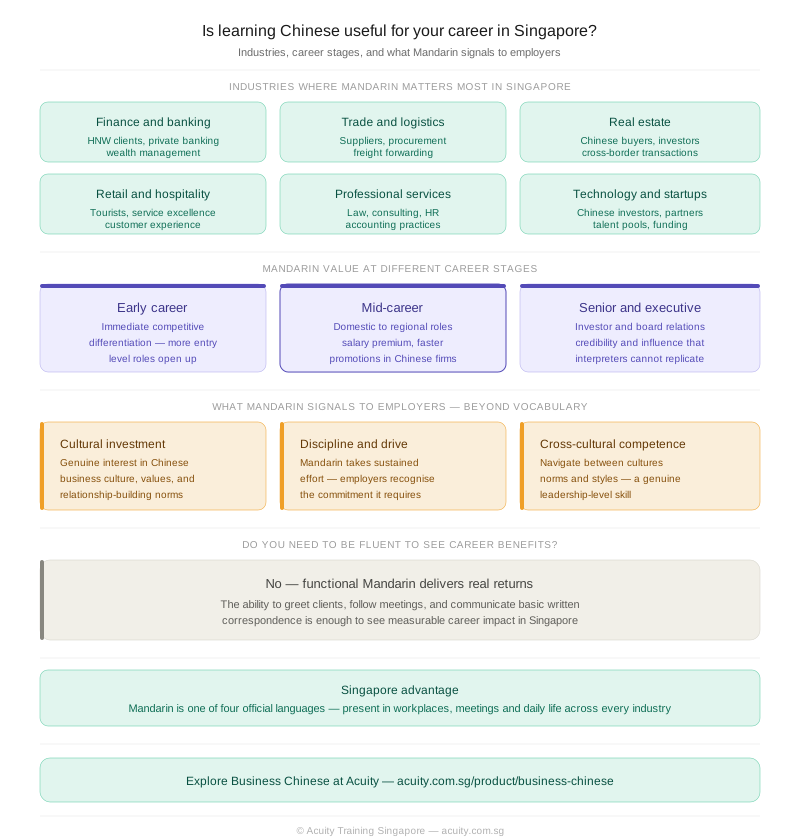
Singapore’s economy does not operate in isolation. As one of Asia’s leading financial and commercial hubs, Singapore sits at the intersection of Western business culture and Chinese-speaking markets across the region — mainland China, Taiwan, Hong Kong, and the large Chinese-speaking communities throughout Southeast Asia.
Mandarin is one of Singapore’s four official languages and the mother tongue of approximately 74% of the Chinese-descended population, which makes up the majority of Singapore’s resident community. In practice, this means Mandarin is present in workplaces, business meetings, client interactions, and informal professional conversations across virtually every industry.
For professionals who cannot communicate in Mandarin, there is an invisible ceiling in many organisations — not a formal barrier, but a real limitation on the depth of relationships, the roles available, and the influence achievable within a Chinese-speaking professional environment.
The professional value of Mandarin varies by industry, but it is relevant across a far wider range of sectors than many professionals realise.
Singapore is one of Asia’s premier financial centres, and many of its major banks, wealth management firms, private banks, and financial institutions serve significant numbers of Chinese-speaking clients — both locally and from mainland China. Relationship managers, private bankers, and financial advisers who can communicate in Mandarin have a distinct advantage in building the trust-based relationships that high-net-worth clients require.
Singapore’s position as a global trade hub means that professionals in procurement, supply chain management, freight forwarding, and international trade regularly deal with Chinese-speaking suppliers, manufacturers, and logistics partners. The ability to communicate in Mandarin removes friction, reduces miscommunication, and often accelerates negotiations and relationship-building significantly.
Both local and cross-border real estate transactions in Singapore frequently involve Chinese-speaking buyers, investors, and developers — from mainland China, Hong Kong, and the broader region. Property agents, developers, and investment professionals who communicate in Mandarin have a clear commercial advantage in this market segment.
Singapore’s retail and hospitality sectors serve large numbers of Chinese-speaking tourists and residents. Front-line service professionals, managers, and business developers who can communicate in Mandarin deliver a better customer experience and are more competitive in the job market.
Singapore’s manufacturing sector — including electronics, precision engineering, and pharmaceutical manufacturing — maintains significant supply chain relationships with Chinese-speaking partners and contractors. Technical and management professionals who can bridge the language gap are highly valued.
Law firms, consulting firms, accounting practices, and HR agencies increasingly serve Chinese-speaking clients and operate within cross-cultural professional environments. Professionals who combine technical expertise with Mandarin communication skills stand out in recruitment and promotion decisions.
Singapore’s tech ecosystem has deep connections with Chinese tech investment, talent, and partnerships. For product managers, business developers, and startup founders, Mandarin proficiency opens doors to Chinese investors, partners, and talent pools that are otherwise difficult to access.
The professional value of Mandarin in Singapore is not anecdotal — it is reflected in hiring patterns, salary data, and employer preferences across industries.
Job postings across Singapore’s major hiring platforms consistently show Mandarin listed as a requirement or strong preference across finance, real estate, retail, logistics, and professional services roles. In many cases, identical roles with and without a Mandarin requirement carry a measurable salary premium for candidates who meet the language criterion.
Singapore’s Ministry of Manpower and major recruitment agencies have consistently noted that bilingual professionals — particularly those who combine strong English with functional or professional Mandarin — command stronger job offers and faster career progression in Chinese-dominant corporate environments.
For professionals targeting regional roles — positions with responsibility across Southeast Asia or the broader Asia-Pacific — Mandarin proficiency is frequently a baseline expectation rather than a differentiator.
The professional value of learning Mandarin goes beyond the practical ability to communicate. Employers and clients draw additional inferences from a professional who has made the effort to develop Chinese language skills.
Taking the time to learn Mandarin signals a genuine interest in understanding Chinese business culture — the values, communication norms, and relationship dynamics that shape how business is done across the Chinese-speaking world. This matters enormously in relationship-driven business cultures where trust is built over time.
Learning Mandarin as an adult — particularly its tonal pronunciation and character-based writing — requires significant sustained effort. Employers recognise this. A professional who has developed functional Mandarin demonstrates the same qualities that make a good hire: persistence, discipline, and the ability to learn difficult things.
In an increasingly globalised workplace, the ability to navigate between cultures — not just languages — is a leadership skill. Mandarin learners develop a sensitivity to Chinese communication styles, negotiation norms, and relationship-building practices that extends well beyond language into genuine cross-cultural competence.
The professional case for learning Mandarin looks slightly different depending on where you are in your career.
For professionals in the first five years of their career, adding Mandarin to their skill set creates immediate competitive differentiation. Many entry-level roles in finance, sales, retail, and logistics explicitly require or prefer Mandarin — and for candidates who can demonstrate even functional Mandarin alongside their technical qualifications, the range of available opportunities expands significantly.
For professionals with five to fifteen years of experience, Mandarin proficiency can be the difference between a domestic role and a regional one. Many senior positions with cross-border responsibility require candidates who can operate comfortably across English and Mandarin-speaking environments.
At the senior and executive level, Mandarin proficiency directly enables relationship-building with Chinese-speaking board members, investors, strategic partners, and government stakeholders. For leaders in Chinese-majority organisations, the ability to communicate in Mandarin — even partially — transforms their credibility and influence in ways that interpreters and intermediaries simply cannot replicate.
Beyond career advancement, functional Mandarin has immediate, practical benefits for working professionals in Singapore’s diverse environment.
In organisations where Mandarin is spoken informally among colleagues — during lunch, in casual meetings, in messaging apps — professionals who understand and can participate in these conversations are more included, more trusted, and more effective as collaborators. Language barriers create invisible distance; removing them builds genuine connection.
Even basic Mandarin — a greeting, a thank you, a few words of acknowledgement in a client’s language — makes a tangible impression. In relationship-driven Chinese business culture, the effort to communicate in Mandarin signals respect and sincerity in a way that polished English alone does not.
Professionals who can follow a Mandarin conversation — even without participating fully — are better informed in mixed-language meetings, less dependent on summaries and translations, and more able to contribute meaningfully in real time.
A significant proportion of business information relevant to Singapore’s economy — news, analysis, regulatory updates, market commentary — is produced in Mandarin. Professionals who can access this content directly have an information advantage over those who rely on translated summaries.
A common misconception is that Mandarin only has career value at near-native fluency. This is not the case.
Even functional Mandarin — the ability to greet clients, participate in simple conversations, follow the general flow of a meeting, and exchange basic written communication — delivers real professional returns. Many Singapore professionals operate effectively in bilingual workplace environments with intermediate Mandarin, complementing their professional expertise rather than replacing it.
A structured Business Chinese course is specifically designed to develop this level of professional competency — not to build academic fluency, but to equip working professionals with the practical communication skills their careers actually require.
If you are convinced that Mandarin has professional value for you, the question becomes where and how to start.
Are you a complete beginner, a heritage speaker with informal Mandarin, or someone with some prior study who has not used the language professionally? Your starting point determines the right programme.
A Business Chinese course is the most efficient path for professionals with specific workplace communication goals. For complete beginners, starting with a foundational Chinese course first — building pronunciation, basic vocabulary, and simple conversation — before moving to business-specific content may be more appropriate.
The most effective Mandarin learning happens when it is connected to real professional context. As you develop skills, use them — in emails, in greetings, in simple workplace exchanges. Every real-world application reinforces what you have learned in class.
Mandarin development requires regular, sustained practice — not occasional bursts of intensive study. Even 20 to 30 minutes of daily practice, maintained consistently over three to six months, produces meaningful workplace-ready improvement.
Acuity’s Business Chinese course is designed specifically for working professionals who want to develop practical, career-relevant Mandarin communication skills — not academic fluency.
For professionals starting from scratch, Acuity’s Chinese Course and Conversational Chinese and Dialect programmes provide the foundational language development needed before advancing to business-specific content.
For English language development alongside Chinese, Acuity offers a Business English Course, General English Course, and IELTS Course.
Not universally — but it is explicitly required or strongly preferred in a wide range of roles across finance, real estate, retail, logistics, and professional services. For roles with regional responsibilities or Chinese-speaking client bases, Mandarin is often a baseline expectation.
Functional Mandarin — the ability to hold simple professional conversations, follow meetings, and communicate basic written correspondence — delivers real career returns. You do not need native-level fluency to benefit professionally from Mandarin skills in Singapore.
Yes. In Singapore’s bilingual business environment, English and Mandarin are complementary rather than interchangeable. Being bilingual opens doors, builds relationships, and signals cultural competence that English-only communication cannot achieve.
With structured learning and consistent practice, most professionals can develop functional workplace Mandarin within three to six months. A Business Chinese course accelerates this by focusing learning on exactly the professional contexts most relevant to your career.
Yes. Acuity’s Business Chinese course offers flexible scheduling with weekday evening and weekend options designed specifically for working professionals. Consistent study of 30 to 60 minutes per day, combined with class attendance, is sufficient for meaningful progress.
Please fill in the following details so we can assist you better.
This will close in 0 seconds