
Mandarin has a reputation for being one of the most challenging languages for English speakers. That reputation is not entirely undeserved — but it is also not the full picture.
The United States Foreign Service Institute (FSI), which trains diplomats in foreign languages, classifies Mandarin as a Category IV language — its hardest category. Their estimate for reaching professional working proficiency is approximately 2,200 class hours for a native English speaker.
However, most learners are not aiming for diplomatic fluency. For everyday conversational ability, workplace communication, or travel purposes, the timeline is considerably shorter — and Singapore’s bilingual environment gives local learners a significant natural advantage.
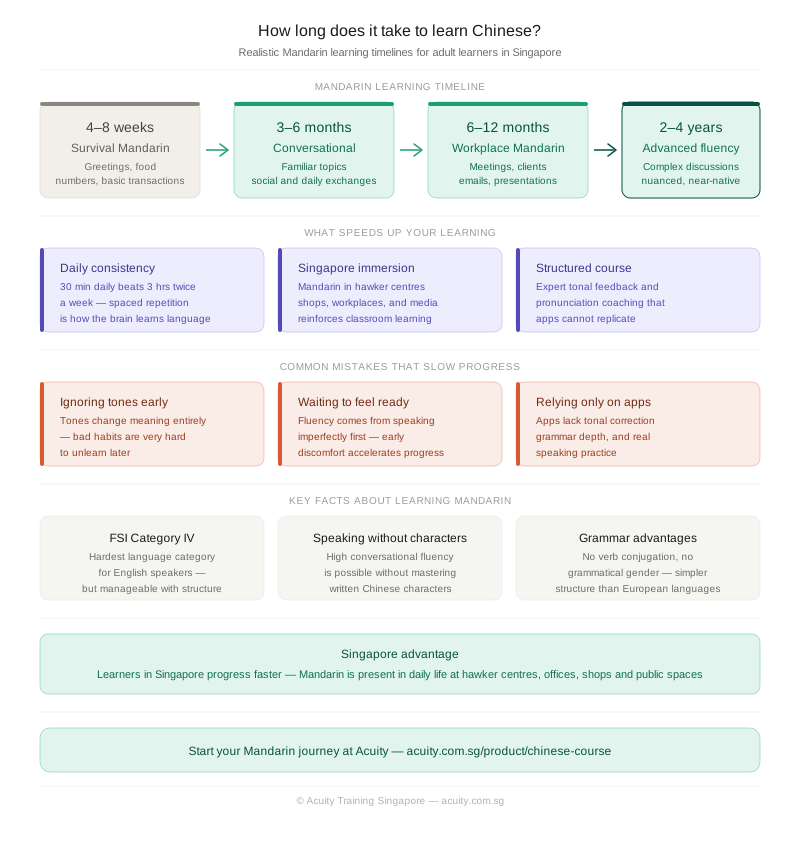
Before thinking about timelines, it is worth being clear about what level of Chinese you actually need. These are very different goals with very different timeframes:
Being able to greet people, order food, ask for directions, handle basic transactions, and count. This is the level most useful for casual daily life and travel.
Holding simple, natural conversations on familiar topics — your job, family, weekend plans, current events. This is the level that opens real social and professional doors in Singapore.
Communicating professionally with Chinese-speaking colleagues and clients — meetings, emails, presentations, negotiations. This requires a broader vocabulary and more precise grammar.
Speaking naturally and confidently across a wide range of topics, with near-native pronunciation and broad vocabulary. This is the level that takes years of sustained effort.
Understanding which level you are targeting is the single most important factor in setting a realistic timeline.
These timelines assume consistent, structured study combined with regular real-world practice — the kind of learning supported by a good Chinese course alongside daily exposure.
With focused daily study of 30 to 45 minutes and two to three hours of class per week, most adult beginners can reach functional survival Mandarin within four to eight weeks.
At this stage you can:
With continued consistent study and active daily practice, most learners reach a comfortable conversational level within three to six months.
At this stage you can:
For professionals who need to use Mandarin in a business context — meetings, client calls, written communication — reaching functional workplace proficiency typically requires six to twelve months of structured study.
At this stage you can:
Professionals looking to develop specifically business-focused language skills may benefit from combining a foundational Chinese course with a Business Chinese programme.
Reaching a high level of fluency — nuanced vocabulary, complex discussions, minimal accent — typically requires two to four years of sustained, immersive effort.
At this stage you can:
The timelines above are guides, not guarantees. Several factors will significantly accelerate or slow your progress:
If you already speak another tonal language — such as Cantonese, Thai, or Vietnamese — you will find Mandarin tones considerably easier to acquire. If you already read any Chinese characters through exposure to other dialects, your reading progress will be faster. Conversely, if English is your only language, tones and characters will require deliberate extra effort.
This is the single biggest variable. A learner who studies 30 focused minutes every day will outperform one who studies three hours twice a week — not because of the total hours, but because language acquisition relies on regular reinforcement and sleep consolidation. Consistency beats intensity every time.
Passive exposure — watching Mandarin TV in the background — produces slower results than active, deliberate practice. The most effective study sessions involve speaking aloud, receiving feedback, reviewing errors, and using new vocabulary in sentences.
Singapore’s environment is a significant advantage for Mandarin learners. The language is present in daily life — in hawker centres, on public transport, in shops and offices. Every interaction outside the classroom is an opportunity to consolidate what you have learned.
Learners with clear, specific goals — a business trip, a family reunion, a promotion that requires Mandarin — consistently progress faster than those with vague aspirations. Having a deadline or a meaningful reason to learn creates urgency that translates directly into more consistent practice.
Self-study through apps and videos can supplement learning effectively, but it rarely replaces the efficiency of structured classroom instruction. A well-structured Chinese course sequences learning logically, provides accountability, and ensures your foundation is solid before moving to more complex material.
Tones are not optional in Mandarin — they change meaning entirely. Many beginners focus on vocabulary and grammar while treating tones as secondary. The result is communication that is frequently misunderstood. Correct tone production must be a priority from lesson one.
Many learners wait until they feel comfortable before speaking. This is a mistake. Fluency comes from speaking — imperfectly at first — and learning from the feedback. The discomfort of early speaking practice is exactly what accelerates progress.
Language apps are useful supplements, but they are not courses. They typically lack the tonal feedback, grammar explanation, cultural context, and speaking practice that structured learning provides. Apps alone rarely take learners beyond survival level.
Taking a week off, then cramming the weekend before class, then taking another week off — this pattern is the most common reason learners plateau. The brain requires regular, spaced exposure to consolidate language learning effectively.
Expecting to speak Mandarin in a month leads to disappointment and abandonment. Setting realistic expectations — survival Mandarin in six to eight weeks, conversational ability in three to six months — allows you to celebrate genuine progress and stay motivated.
Singapore offers learners something rare — a genuine language immersion environment without leaving home. Mandarin is spoken in shops, at food courts, in offices, on television, and in community spaces every day. For learners taking a structured Chinese course in Singapore, this ambient exposure compounds the learning significantly. This is one of the reasons that motivated adult learners in Singapore often progress faster than the FSI’s general estimates suggest.
For many adult learners, the priority is spoken Mandarin — and this is a perfectly valid goal. You can reach a high level of conversational fluency without mastering written characters.
However, being able to read simplified Chinese characters opens significant additional doors — reading menus, signs, messages, and basic documents becomes possible, and digital communication with Chinese-speaking contacts becomes much easier.
Most beginner courses introduce Pinyin — the romanised phonetic system — alongside basic characters. Learners who want to develop reading and writing more seriously can build this skill progressively as their spoken foundation develops.
Acuity’s Chinese Course is designed for adult learners at every stage — from complete beginners building their first Mandarin foundation to more advanced learners looking to strengthen their conversational or professional communication skills.
For learners with professional goals, Acuity also offers a Business Chinese course and a Conversational Chinese and Dialect programme. For English language development alongside Chinese, Acuity also offers a General English Course, Business English Course, and IELTS Course.
Yes — with consistent daily study of 30 to 45 minutes and structured class time, most adult beginners can reach survival Mandarin within four to eight weeks. You will not be fluent, but you will be able to handle basic everyday interactions confidently.
Most adult learners make strong progress with 30 to 60 minutes of focused daily self-study, combined with regular class attendance. The key is daily consistency rather than longer but infrequent sessions.
Mandarin presents specific challenges for English speakers — particularly tones and the character writing system. However, it also has advantages: no verb conjugations, no grammatical gender, and relatively straightforward sentence structure. With the right instruction and consistent practice, adult learners make meaningful progress faster than they expect.
Significantly. The daily ambient exposure to Mandarin in Singapore’s bilingual environment provides natural reinforcement of classroom learning. Learners in Singapore who actively engage with the language in daily life consistently progress faster than those studying in English-only environments.
A structured course with experienced instructors — combined with daily practice and active use of the language in Singapore’s Mandarin-rich environment — is the most effective approach.
Please fill in the following details so we can assist you better.
This will close in 0 seconds