

Workplace Safety Training for New Employees in Singapore

The first weeks of any new job carry a disproportionate share of workplace safety risk. New employees are unfamiliar with the specific hazards of their new workplace, have not yet developed the routines and situational awareness that experienced workers build over time, and may be reluctant to ask questions or raise concerns while they are still finding their feet.

Singapore’s Workplace Safety and Health (WSH) Act recognises this reality. The legal obligation on employers to provide adequate information, instruction, training, and supervision applies from day one of employment — and the consequences of failing to properly induct and train new workers can be serious for both the individual and the organisation.

Table of Contents
workplace safety training singapore

Why New Employees Face Higher Safety Risk

Research consistently shows that workplace accidents are disproportionately likely to involve relatively new employees. The reasons are well understood:

  • Unfamiliarity with the workplace — new employees have not yet learned where the hazards are, which surfaces are slippery, or which tasks carry the highest risk
  • Lack of established safe work routines — experienced workers apply safe work habits automatically; new employees are still learning what safe looks like
  • Reluctance to raise concerns — new employees often do not want to appear incompetent by asking safety questions or raising concerns
  • Eagerness to demonstrate competence — new employees may take on tasks beyond their training or work faster than is safe
  • Insufficient supervision — busy workplaces sometimes assign new employees to independent work before their competency has been confirmed

What Singapore’s WSH Act Requires for New Employee Training

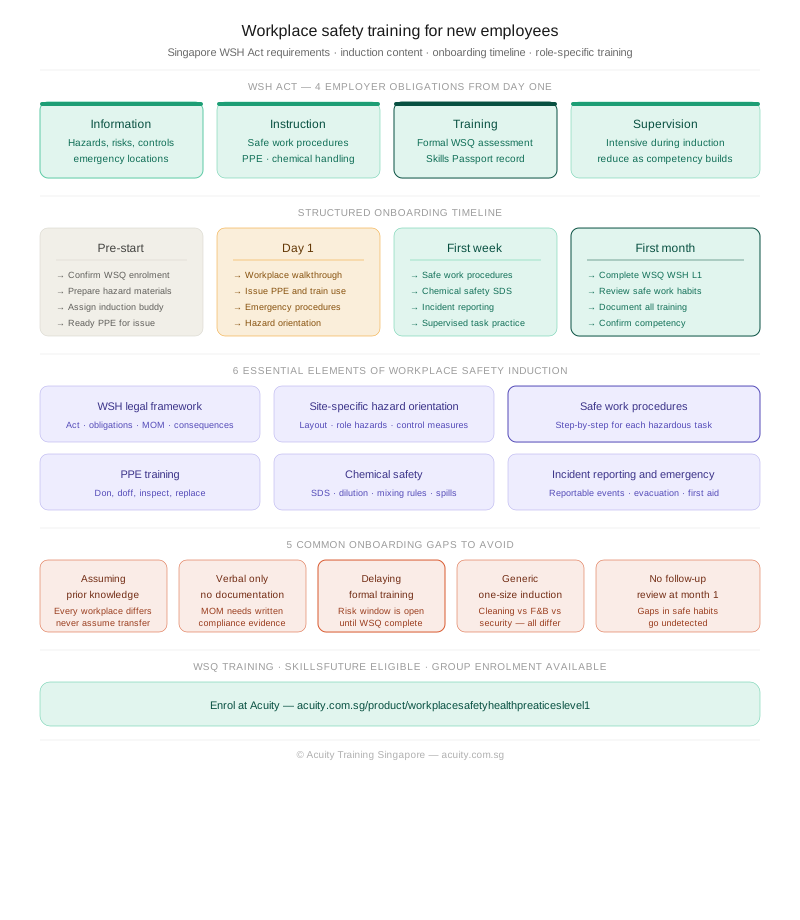
Under the Workplace Safety and Health Act, employers have a legal obligation to provide adequate information, instruction, training, and supervision to all employees from day one.

Information

New employees must be given relevant information about the specific hazards in their workplace — including:

  • The nature of the hazards they will encounter in their role
  • The risks those hazards create and potential consequences of exposure
  • The control measures in place to manage each hazard
  • The locations of safety equipment, first aid facilities, and emergency exits
  • The identity of the designated first aider and WSH officer where applicable

Instruction

New employees must receive clear instruction on how to carry out their work safely — including:

  • Specific safe work procedures for hazardous tasks in their role
  • How to correctly select, use, inspect, and remove personal protective equipment
  • How to handle, store, and dispose of chemical products safely
  • What to do if they encounter an unsafe condition or are unsure how to perform a task safely

Supervision

New employees must be adequately supervised — particularly in the period before their competency in safe work practices has been confirmed. Supervision requirements are more intensive during induction and should be progressively reduced as the new employee demonstrates safe work habits.

Training

Training goes beyond instruction — it involves supervised practice and confirmation that the new employee can apply the required knowledge and skills. Formal WSQ training — such as Workplace Safety and Health Practices Level 1 — provides the structured, assessed training that employers need to demonstrate this requirement has been fulfilled.

What Should Workplace Safety Induction Cover for New Employees?

A comprehensive workplace safety induction for new employees in Singapore’s service sectors should cover the following areas.

The WSH Legal Framework

New employees should understand the legal framework that governs workplace safety in Singapore:

  • The purpose and scope of the Workplace Safety and Health Act
  • Their own responsibilities as an employee — taking reasonable care, following procedures, reporting hazards
  • The consequences of non-compliance for both themselves and their employer
  • The role of MOM as the primary enforcement authority

Site-Specific Hazard Orientation

Generic WSH training must be supplemented with orientation to the specific hazards of the new employee’s actual workplace:

  • The physical layout of the workplace — hazardous areas, restricted zones, safe pedestrian routes
  • The specific hazards in the new employee’s role — wet floors, chemical handling, heat stress, confrontation risks
  • The specific control measures in place for each hazard
  • Emergency procedures specific to the workplace — evacuation routes, assembly points

Safe Work Procedures

New employees must be trained in safe work procedures for their role before performing hazardous tasks independently:

  • Step-by-step procedures for each hazardous task in their role
  • The specific control measures and PPE required at each step
  • What to do if something goes wrong during a task
  • Who to contact for guidance if they are unsure how to proceed safely

Personal Protective Equipment

New employees must be trained in PPE before they are required to use it:

  • What PPE is required for each task in their role
  • How to correctly don, doff, and adjust each type of PPE
  • How to inspect PPE before use and identify defects
  • What to do with damaged or contaminated PPE

Chemical Safety

For new employees in cleaning, FM, and food service roles, chemical safety training is critical:

  • The specific chemical products they will use — including hazards associated with each
  • How to read and interpret Safety Data Sheets (SDS)
  • Correct dilution procedures for cleaning concentrates
  • Which chemicals must never be mixed — and why
  • How to respond to a chemical spill or accidental exposure

Incident Reporting and Emergency Response

Every new employee should know from day one:

  • What constitutes a reportable incident under the WSH Act
  • How to report a workplace accident, near miss, or unsafe condition
  • Basic emergency response procedures — evacuation, fire response, first aid summoning
  • The location of first aid equipment and the identity of the first aider

The Role of Formal WSQ Training in New Employee Onboarding

Formal WSQ training and site-specific orientation are complementary — not alternatives. Formal WSQ training without site-specific orientation leaves new employees without specific knowledge of their actual workplace. Site-specific orientation without formal WSQ training leaves gaps in foundational knowledge and fails to provide the documented evidence of compliance.

Acuity’s Workplace Safety and Health Practices Level 1 course provides new employees with comprehensive understanding of Singapore’s WSH legal framework, practical hazard identification skills, risk assessment knowledge, safe work procedures, PPE, chemical safety, incident reporting, and a formally assessed WSQ qualification on their SkillsFuture Skills Passport.

When Should Formal WSQ Training Take Place?

Formal WSQ WSH training should ideally be completed before or within the first few weeks of employment. Where operational pressures make this difficult, new employees should receive comprehensive site-specific induction first, with formal WSQ training scheduled and confirmed within the onboarding period.

Building a Structured New Employee WSH Onboarding Programme

A well-structured new employee WSH onboarding programme ensures consistent, comprehensive safety orientation for every new hire, provides documented compliance evidence, and sets clear safety expectations from day one.

Pre-Start Preparation

Before the new employee’s first day:

  • Identify all WSH training required for the new employee’s role
  • Confirm enrolment in Workplace Safety and Health Practices Level 1 if not already completed
  • Prepare site-specific induction materials — hazard maps, safe work procedures, PPE guidance
  • Assign a supervisor or buddy responsible for supervising during the induction period

First Day

On day one:

  • Conduct a physical walkthrough of the workplace — identifying hazardous areas, emergency exits, first aid locations
  • Review site-specific hazards and control measures relevant to the new employee’s role
  • Issue required PPE and provide initial PPE training
  • Introduce emergency response procedures — evacuation routes, assembly points, first aider contact

First Week

During the first week:

  • Deliver instruction on safe work procedures for each hazardous task — before independent performance
  • Provide chemical safety briefing and introduction to relevant Safety Data Sheets
  • Confirm understanding of incident reporting procedures
  • Begin supervised practice of hazardous tasks with progressive reduction as competency develops

Within the First Month

By the end of the first month:

  • Complete formal WSQ Workplace Safety and Health Practices Level 1 training
  • Conduct a first review of the new employee’s safe work practices
  • Document the completion of all onboarding WSH training elements

Technical WSH Onboarding for Specific Service Sector Roles

Cleaning and Facilities Management Roles

For new cleaning and FM staff, onboarding WSH training should be combined with WSQ cleaning module training:

Food Service and Institutional Catering Roles

For new food service staff, WSH onboarding should be combined with food safety certification:

Security Roles

For new security officers, WSH onboarding should complement their licensing training — the Security Officer BLU Course — to address the specific hazard profile of public-facing security roles.

Customer-Facing Service Roles

For new employees in customer-facing environments, Customer Management Level 1 complements WSH onboarding with communication, complaint handling, and professional service conduct skills.

Common Gaps in New Employee WSH Onboarding

Assuming Prior Knowledge

A common error is assuming that a new employee’s previous work experience means they already know the WSH requirements of their new role. Every workplace has specific hazards, control measures, and safe work procedures — none of which can be assumed to transfer from a previous employer.

Verbal Induction Without Documentation

Verbal induction delivered informally during a first day tour is not sufficient to demonstrate that adequate training has been provided. Documentation — signed induction checklists, training records, WSQ certificates — is essential evidence of WSH compliance.

Delaying Formal Training

Operational pressure sometimes leads employers to delay formal WSH training. This creates a period of unacceptable risk and potential WSH Act non-compliance. Formal WSQ training should be scheduled before employment begins or within a defined and documented timeline.

One-Size-Fits-All Induction

A generic induction that does not address the specific hazards of the new employee’s role is less effective than role-specific WSH orientation. New cleaning staff need different hazard orientation from new kitchen staff or new security officers.

No Follow-Up Review

Initial induction establishes safety knowledge — but safe work habits are built through supervised practice and reinforcement. The absence of a structured follow-up review within the first month means gaps in safe work practices may go unidentified.

Can SkillsFuture Credit Be Used for New Employee WSH Training?

Yes. The WSQ Workplace Safety and Health Practices Level 1 course is an approved SSG programme. Eligible Singapore Citizens aged 25 and above may be able to use their SkillsFuture Credit to offset the cost of training. For employers arranging training for multiple new employees, Acuity can discuss group enrolment arrangements to make new employee WSH onboarding cost-effective across an entire intake.

How Acuity Supports New Employee Workplace Safety Training in Singapore

Acuity’s Workplace Safety and Health Practices Level 1 course is specifically designed for workers in Singapore’s service sector — with content directly relevant to the hazard environments that new cleaning, FM, food service, and security employees encounter from their very first day.

What New Employee Learners Can Expect

  • Structured instruction covering all WSQ competency requirements — accessible and relevant to new workers at any career stage
  • Practical, scenario-based learning applicable to real service sector workplaces
  • Clear assessment preparation for both written and practical components
  • A nationally recognised WSQ qualification on their SkillsFuture Skills Passport
  • Guidance on SkillsFuture Credit and available subsidies to reduce onboarding training costs

Frequently Asked Questions

Is workplace safety induction mandatory for new employees in Singapore?

Under the WSH Act, employers must provide adequate information, instruction, training, and supervision to all employees from the first day of employment. Employers who fail to properly induct new employees and whose workers suffer injury are likely to be found in breach of their WSH obligations.

When should new employees complete WSQ workplace safety training?

Ideally, formal WSQ WSH training should be completed before or within the first few weeks of employment. Where operational pressures prevent this, comprehensive site-specific induction should be provided immediately, with formal WSQ training scheduled and completed within the onboarding period.

What documentation should employers keep for new employee WSH training?

Employers should maintain records of all WSH training including signed induction checklists, training attendance records, and WSQ certificates. These records provide evidence of WSH compliance during MOM workplace inspections and following workplace incidents.

What is the difference between a WSH induction and formal WSQ training?

A WSH induction addresses site-specific hazards and procedures relevant to the new employee’s specific workplace. Formal WSQ training develops foundational WSH competency assessed against national standards. Both are required — they complement each other and cannot substitute for each other.

Can group enrolment be arranged for multiple new employees?

Yes. Acuity can discuss group enrolment arrangements for the WSQ Workplace Safety and Health Practices Level 1 course — making formal WSH training cost-effective across an entire new intake.

Download Brochure

Please fill in the following details so we can assist you better.


    This will close in 0 seconds

    Enquire now

    Fill up your contact details below so we can get in touch with you as soon as possible.