
In Singapore’s competitive professional landscape, language skills are not just a personal asset — they are a career differentiator. The ability to communicate across linguistic boundaries opens doors that technical skills alone cannot.
The case for language learning in Singapore is both practical and long-term:
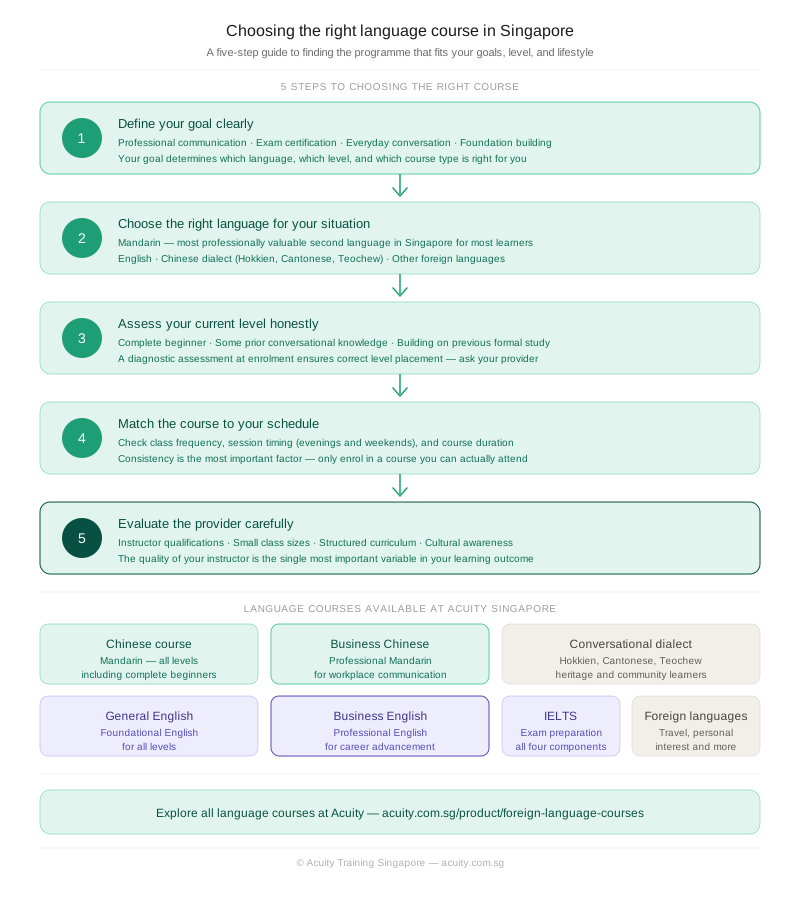
The most common mistake language learners make is enrolling in a course before clearly defining what they actually want to achieve. Your goal determines everything — which language, which level, which course type, and how much time to invest.
If your goal is workplace Mandarin, a Business Chinese course delivers professional vocabulary, meeting and email language, negotiation skills, and cross-cultural business awareness. Similarly, for professional English communication, a Business English Course is more targeted than a general English programme.
If your goal is IELTS for university admission or migration, an IELTS Course is structured around all four test components — Listening, Reading, Writing, and Speaking — with mock examinations and targeted band score preparation.
If your goal is everyday conversation, a Chinese course or a Conversational Chinese and Dialect programme for heritage learners suits this goal better than a business-focused syllabus.
If your goal is to build a solid foundation, a General English Course or beginner Mandarin programme gives you the vocabulary, grammar, and pronunciation base needed to progress confidently.
Singapore’s multilingual environment means learners genuinely have meaningful choices about which language to study.
Mandarin is Singapore’s most valuable second language for professional purposes. It is spoken by the majority of Singapore’s resident population and is the language of business across China, Taiwan, Hong Kong, and the wider Chinese-speaking world.
Mandarin is the right choice if you are working in an industry with significant Chinese-speaking relationships, managing a Mandarin-dominant team, expanding into regional markets, a heritage learner wanting to formalise your skills, or a complete beginner wanting the most professionally valuable second language in Singapore.
For many Singapore residents whose first language is Mandarin, Malay, Tamil, or a regional dialect, English is a second language that benefits from structured development — particularly for professional contexts, IELTS preparation, or improving writing and presentation skills.
Singapore has a rich dialect heritage — Hokkien, Cantonese, Teochew, Hakka, and others are spoken widely in older generations. For learners motivated by family connection, community engagement, or cultural heritage, dialect learning offers something Mandarin alone cannot.
For learners interested in languages beyond English and Mandarin, Acuity’s Foreign Language Courses provide structured instruction across a range of additional language options.
Enrolling in a course that is too advanced leads to frustration and disengagement. Enrolling in one that is too basic wastes your time and money. An honest self-assessment — or a diagnostic assessment from the provider — is essential before committing to a programme.
If you are a complete beginner, look for a course that starts with the absolute basics — pronunciation, the phonetic system, basic vocabulary, and elementary grammar. Do not skip this stage — a weak foundation leads to persistent errors that become harder to correct later.
If you have some prior knowledge, look for a diagnostic assessment that places you correctly within the programme. A good provider will not ask you to repeat content you already know.
One of the most common reasons language learners drop out is choosing a course that does not fit their lifestyle. Consistency is the most important factor in language progress — and consistency is only possible when the course fits realistically into your life.
Acuity offers flexible scheduling across its full range of language courses — with weekday evening and weekend options designed specifically for working professionals.
Not all language course providers in Singapore deliver the same quality of instruction. Here is what to look for before committing to a course.
The quality of your instructor is the single most important variable in your learning outcome. Look for native or near-native speakers, formal teaching qualifications, specific experience teaching adult learners, and a track record with learners at your level and with your goals.
Large classes limit individual feedback and speaking practice — the two most important elements of language acquisition. Look for providers who keep class sizes small enough for genuine individual attention, particularly for speaking and pronunciation development.
A good language course is a structured progression that builds skills systematically. Ask how the course builds from one level to the next, whether there is a clear syllabus, and whether there is regular assessment and feedback on your progress.
Language and culture are inseparable. The best language courses go beyond vocabulary and grammar to include cultural awareness — business etiquette, cultural context, and examination-specific conventions.
Acuity offers a comprehensive suite of language programmes designed for adult learners at every level and with every goal.
Acuity’s language programmes are built around the specific needs of adult learners in Singapore’s professional environment.
For most professionals in Singapore, Mandarin is the most valuable language investment — particularly a Business Chinese course focused on professional communication. For those in international English-language environments, a Business English Course delivers targeted professional communication skills.
Most structured language courses run for eight to sixteen weeks per level. Reaching functional proficiency in a new language typically requires consistent study over three to twelve months, depending on the language and your starting level.
Yes. Acuity’s language courses offer weekday evening and weekend scheduling specifically designed for working professionals. Consistent attendance combined with 20 to 30 minutes of daily self-study is sufficient for meaningful progress.
No. Beginner programmes are designed for learners with zero prior exposure to the target language. A diagnostic assessment at enrolment ensures you are placed at the right level.
If you have a specific professional or examination goal, a specialist course delivers faster, more targeted results. If you are building foundational language skills, start with a general course and progress to the specialist programme once your foundations are established.
Please fill in the following details so we can assist you better.
This will close in 0 seconds