

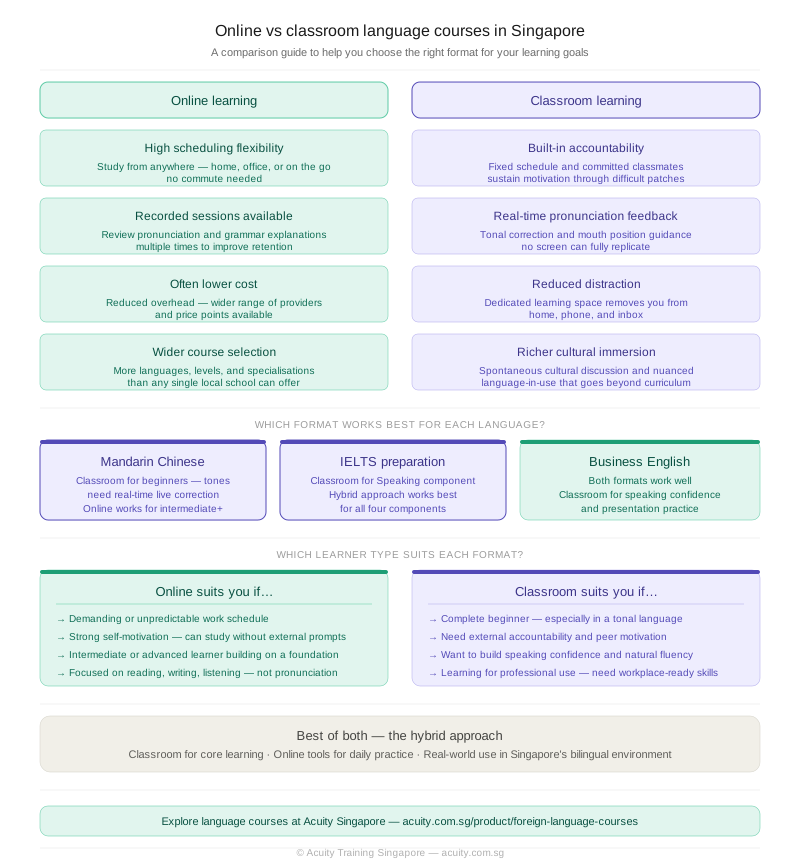
The landscape of language education in Singapore has shifted significantly over the past few years. Online learning — once seen as a compromise option — has matured into a genuinely effective format for many learners. At the same time, in-person classroom instruction has adapted, with many providers now offering hybrid options that blend both approaches.
Singapore’s infrastructure makes both formats accessible. High-quality internet connectivity, widespread digital literacy, and a dense concentration of reputable language schools mean learners genuinely have a choice — rather than defaulting to one format out of necessity.
The question is not which format is better in the abstract. It is which format is better for you, your language, and your goals.
Online language courses have evolved well beyond recorded video lectures. Today’s online learning platforms and live virtual classes offer interactive, real-time instruction that closely mirrors the classroom experience — with some meaningful additional advantages.
This is the most significant advantage of online learning for working professionals. Online classes can be attended from anywhere — your home, your office, or while travelling — without commuting time adding to an already full day. For Singapore professionals juggling demanding work schedules, family commitments, and long commutes, the ability to join a class from a laptop at home in the evening removes one of the biggest practical barriers to consistent language study.
Online platforms can offer a broader selection of languages, levels, and specialisations than any single physical school. For learners studying less commonly taught languages — or looking for highly specific content such as business-focused or dialect programmes — online options may provide access that local classroom provision cannot match.
Some online language programmes offer self-paced modules alongside or instead of live instruction. This allows learners to move faster through content they find easy and spend more time on areas of difficulty — something a standardised classroom curriculum cannot always accommodate.
Many online courses allow learners to revisit recorded sessions after class. This is particularly valuable for language learning, where reviewing pronunciation, vocabulary, and grammar explanations multiple times significantly improves retention.
Online courses sometimes carry lower fees than equivalent in-person programmes due to reduced overhead costs. However, the quality gap between providers is significant — a well-delivered online course from an experienced provider is not necessarily cheaper than in-person instruction.
In-person language instruction has been the dominant format for language education for generations — not out of tradition, but because it delivers specific learning outcomes that online formats genuinely struggle to replicate.
This is the area where in-person instruction holds its clearest advantage. Pronunciation — particularly tonal pronunciation in Mandarin, or the sounds of languages that do not exist in English — requires an instructor who can observe your mouth position, correct your tone in real time, and demonstrate sounds in a way that a screen simply cannot fully replicate.
Conversation happens differently in a room than on a screen. The natural rhythm of turn-taking, the subtle cues of body language, the ability to speak spontaneously without the friction of unmuting yourself — these elements of in-person interaction produce a more authentic rehearsal of real-world communication.
Physically attending a class at a set time and place creates a level of commitment and accountability that online learning — however convenient — sometimes lacks. The social dimension of seeing the same classmates each week, building relationships, and not wanting to fall behind creates a motivational dynamic that sustains learning through the inevitable difficult patches.
The classroom environment — by removing you from your home, your phone, your work inbox, and every other competing demand on your attention — creates a focused learning space that many learners find significantly more productive than studying from home.
In-person language instruction, particularly with experienced teachers, provides opportunities for cultural context, spontaneous cultural discussion, and nuanced explanation of language in use that goes beyond what a structured curriculum can capture.
Here is how the two formats compare across the factors that matter most for language learners:
Factor | Online | Classroom |
Scheduling flexibility | High — study from anywhere | Fixed schedule and location |
Pronunciation feedback | Limited by screen | Real-time, in-person correction |
Conversation practice | Possible but less natural | Natural, face-to-face interaction |
Accountability | Self-driven | Built-in through attendance |
Distraction level | Higher — home environment | Lower — dedicated learning space |
Access to courses | Wider selection online | Limited to local providers |
Cultural immersion | Reduced | Richer classroom dynamic |
Session review | Often available (recordings) | Generally not available |
Commute required | No | Yes |
Cost | Often lower | Varies — may be higher |
Best for | Flexible learners, busy professionals | Pronunciation-focused, beginners |
The right format also depends on which language you are learning. Different languages have different instructional priorities that make one format more suitable than the other.
Mandarin’s tonal nature makes in-person instruction particularly valuable for beginners. The four tones require real-time feedback on both pronunciation and the physical production of sound. Acuity’s Chinese course and Business Chinese programmes are designed with this in mind — giving learners the structured, feedback-rich environment that Mandarin’s tonal foundation requires.
Business English instruction adapts well to both formats. However, speaking confidence and real-time presentation practice benefit from in-person interaction. Acuity’s Business English Course provides structured in-person instruction with emphasis on real workplace communication scenarios.
IELTS preparation involves four components. Speaking benefits most from in-person instruction, simulating a face-to-face examiner interaction. Acuity’s IELTS Course focuses on all four components in a structured classroom setting with mock examinations.
General English is one of the formats most successfully delivered online for intermediate learners. Beginners, however, tend to benefit more from in-person instruction. Acuity’s General English Course provides this structured foundation for learners at all levels.
Learning conversational dialect almost always benefits from in-person instruction. Acuity’s Conversational Chinese and Dialect programme is specifically designed for this purpose.
For many learners in Singapore, the most effective approach is not a binary choice between online and classroom — it is a deliberate combination of both.
A common and highly effective pattern:
This hybrid approach captures the accountability, pronunciation feedback, and conversational richness of in-person instruction while leveraging the flexibility and supplementary resources that online tools provide.
Before enrolling in either an online or classroom programme, ask yourself:
Acuity offers a comprehensive range of language courses designed for adult learners in Singapore — with structured classroom instruction that provides the accountability, feedback, and cultural immersion that language learning requires.
For beginners learning Mandarin, in-person instruction is generally more effective — particularly for tonal pronunciation, which requires real-time correction that screens cannot fully replicate. For intermediate and advanced learners, both formats can work well.
Yes — with the right programme and consistent practice. Online learning is most effective for intermediate and advanced learners, for skills like reading and listening, and for learners with strong self-motivation. Beginners and those focused on pronunciation typically progress faster with in-person instruction.
Consider your learning level, schedule, motivation, and the language you are studying. Beginners in phonetically complex languages benefit most from classroom instruction. Busy professionals may find online options more sustainable. A hybrid approach often works best for motivated adult learners.
Not necessarily. The cost difference depends on the provider, the programme, and what is included. A well-structured classroom course from an experienced provider may be comparable in price to a quality online programme — and delivers outcomes that self-paced apps and cheaper online courses cannot match.
Yes. Acuity’s language courses are scheduled with working professionals in mind — offering weekday evening and weekend class options across its full range of language programmes.
Please fill in the following details so we can assist you better.
This will close in 0 seconds