

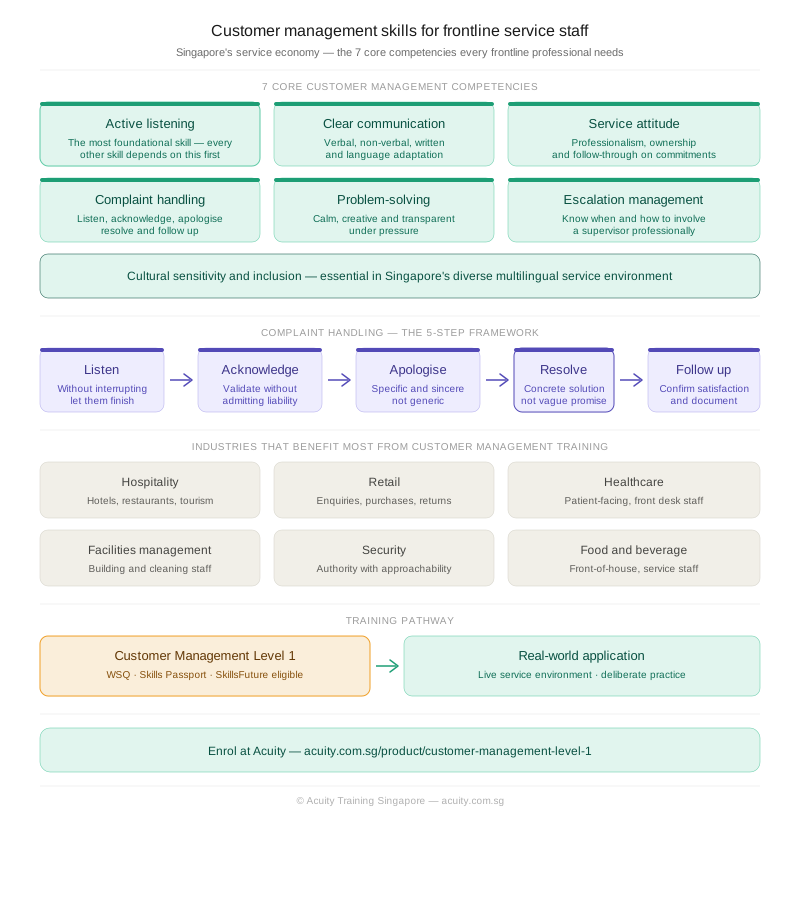
Customer management, in the context of frontline service roles, refers to the full range of skills involved in handling customer interactions effectively — from the moment a customer approaches to the resolution of any issues that arise.
It encompasses:
Singapore consistently ranks among the most competitive business environments in the world. Customer expectations are high — and with online review platforms, social media, and word-of-mouth amplifying both positive and negative experiences, the stakes for frontline service quality have never been higher.
The WSQ Service Excellence framework — which underpins courses like Customer Management Level 1 — was developed specifically to raise the baseline of service competency across Singapore’s workforce.
Active listening is perhaps the most underestimated skill in customer management. Most service failures begin not with an inadequate response, but with an inadequate understanding of what the customer actually needed.
Active listening involves giving the customer your full attention before responding, acknowledging what you have heard, asking clarifying questions when needed, picking up on emotional cues, and resisting the impulse to interrupt or redirect before the customer has finished.
Communication in a frontline service context is about being clear, accurate, and helpful in a way the customer can act on. Key competencies include verbal clarity, language adaptation for different customers, non-verbal communication through body language and eye contact, and professional written communication for digital channels.
The attitude a frontline staff member brings to a customer interaction is visible immediately. Service attitude includes greeting customers proactively, maintaining composure in high-pressure situations, taking ownership of customer issues, following through on commitments, and treating every customer with respect regardless of the circumstances.
Effective complaint handling follows a clear structure:
The ability to problem-solve calmly and creatively under pressure separates genuinely effective frontline staff from those who can only handle routine interactions. This involves staying calm when situations escalate, thinking creatively about alternative solutions, knowing the boundaries of your authority, and communicating transparently with the customer about what you are doing.
Not every customer issue can be resolved at the frontline level. Knowing when to escalate — and how to do so professionally — protects both the customer and the frontline staff member. Effective escalation involves recognising when supervisor involvement is needed, communicating clearly with the customer about what is happening, and briefing the supervisor accurately so the customer does not have to repeat themselves.
Singapore’s workforce and customer base reflect exceptional cultural diversity. Cultural sensitivity means avoiding assumptions about customer preferences based on appearance or perceived background, being aware of cultural differences in directness and formality, adapting your communication approach, and treating all customers with equal respect and attention.
Angry or aggressive customers are one of the most stressful aspects of frontline service work. Effective training helps staff understand that customer aggression is almost always directed at the situation rather than the individual — and provides specific techniques for de-escalating tension and maintaining composure.
During peak periods, service quality can deteriorate as staff become stretched and stressed. Training that builds automaticity in customer management skills — where the right response becomes instinctive — helps staff maintain quality even under volume pressure.
Frontline staff increasingly manage customer interactions across multiple channels — in person, by phone, via messaging apps, and social media. The core skills translate across channels, but each has specific conventions that staff need to understand.
Singapore’s diverse customer environment means frontline staff regularly navigate cultural differences in a single shift. Training that develops genuine cultural awareness helps staff handle this complexity with skill and sensitivity.
Customer management skills can be developed through experience alone — but this is slow, inconsistent, and depends heavily on the quality of informal role modelling. Structured training accelerates development, ensures consistency, and builds the conceptual framework that helps staff understand why certain approaches work.
Acuity’s Customer Management Level 1 course is designed specifically to develop these competencies for frontline service staff in Singapore’s diverse service environments.
Customer management competency does not exist in isolation. The most effective frontline service professionals combine strong customer management skills with complementary professional development.
For cleaning professionals in customer-facing environments, combining Customer Management Level 1 with Washroom Maintenance Level 1, Horizontal Surface Maintenance Level 1, and Furniture and Furnishing Maintenance Level 1 creates a comprehensive professional profile that combines technical competency with people skills.
For security professionals, combining the Security Officer BLU Course with customer management training creates the blend of authority, professionalism, and approachability that high-quality security roles require.
For food service professionals, customer management skills complement WSQ Food Safety Level 1 certification — ensuring front-of-house staff bring both food safety compliance and genuine service skill to every interaction.
Acuity’s Customer Management Level 1 course is designed for frontline service professionals across Singapore’s diverse service sectors.
Active listening is arguably the most foundational — every other customer management skill depends on first understanding what the customer actually needs. Staff who listen well make fewer errors, handle complaints more effectively, and create interactions that feel genuinely personalised.
They can absolutely be learned — and structured training significantly accelerates their development. The specific frameworks, techniques, and situational awareness that make customer management skills reliable under pressure are developed through structured learning and deliberate practice.
Foundational competency can be developed through a structured Customer Management Level 1 programme in a short period — and then deepened through real-world practice over time. Structured training followed by consistent application produces the fastest and most durable skill development.
Yes. Acuity’s Customer Management Level 1 is a WSQ-aligned programme — the qualification is recorded on your SkillsFuture Skills Passport and SkillsFuture Credit may be available to offset training costs.
Hospitality, retail, healthcare, food and beverage, facilities management, security, public services, and any sector where direct customer interaction is a core part of frontline role responsibilities.
Please fill in the following details so we can assist you better.
This will close in 0 seconds