

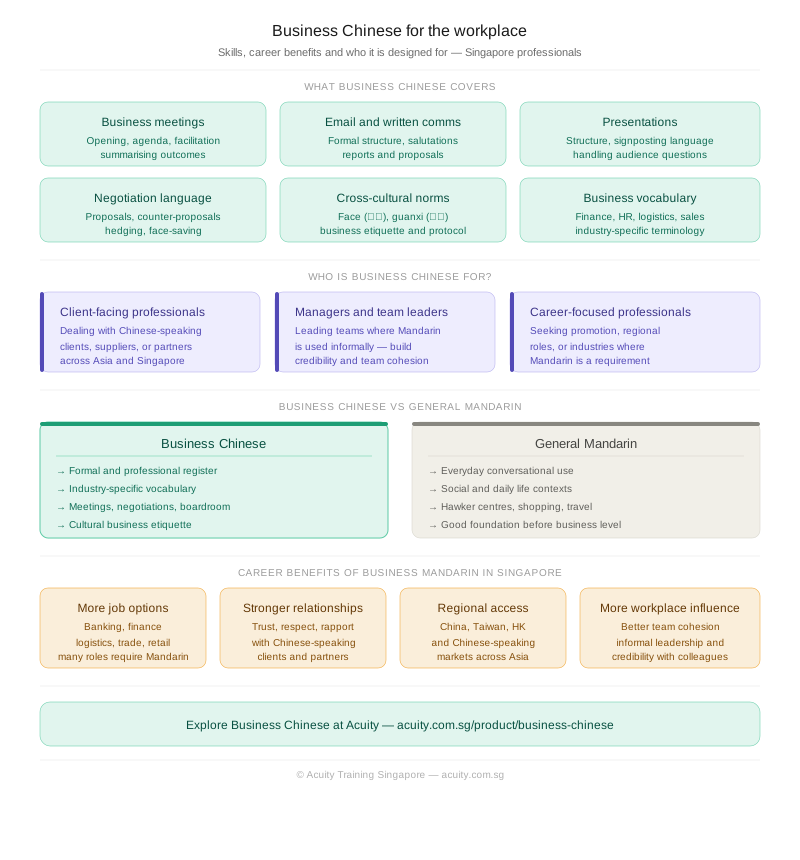
 Business Chinese is a specialised form of Mandarin language training focused on professional communication in workplace contexts. Unlike general Mandarin courses — which build everyday conversational ability — a business Chinese programme develops the specific vocabulary, register, and communication skills needed to function confidently in professional and corporate settings.
The focus is on practical, high-stakes communication:
Business Chinese is not about being perfectly fluent — it is about being professionally effective. A learner who can participate in a meeting, follow a negotiation, and write a clear email in Mandarin has a significant advantage over one who cannot, regardless of whether their Mandarin is native-level or not.
Business Chinese is relevant to a wide range of professionals in Singapore’s diverse economy.
Singapore’s position as a regional business hub means many professionals regularly interact with Chinese-speaking clients, suppliers, and partners — from mainland China, Taiwan, Hong Kong, and across Southeast Asia. Being able to communicate even partially in Mandarin demonstrates respect, builds trust, and often changes the dynamic of a business relationship entirely.
Leaders managing teams where Mandarin is the dominant language of informal communication can significantly improve team cohesion, engagement, and effectiveness by developing their own business Chinese skills. Understanding what is being said — and being able to respond — removes barriers and builds credibility as a leader.
In many Singapore industries — finance, logistics, trade, manufacturing, hospitality, and retail — the ability to communicate in Mandarin is explicitly listed as a job requirement or a preferred qualification. Developing business Chinese skills can directly expand your career options, increase your competitiveness for promotions, and open access to regional roles that require cross-cultural communication.
For business owners looking to grow their customer base, attract Chinese-speaking investors, or expand into Chinese-speaking markets, professional Mandarin communication is an invaluable commercial asset.
Many Singaporeans grew up speaking some Mandarin at home but never developed formal professional communication skills in the language. Business Chinese bridges this gap — helping heritage learners translate informal language ability into confident workplace performance.
A well-designed business Chinese course for the workplace goes well beyond vocabulary lists and grammar drills. It develops practical communication competency across the full range of professional contexts.
General Mandarin vocabulary is insufficient for the workplace. Business Chinese develops industry-relevant terminology across key professional domains:
Meetings are one of the most high-pressure communication contexts for any professional. Business Chinese training covers:
Written Mandarin in a business context follows different conventions from spoken communication. Business Chinese training covers:
Presenting in a second language requires specific preparation and skills. Business Chinese training develops:
Negotiation in Mandarin requires nuance — the language of proposals, counter-proposals, concessions, and agreement has specific conventions in Chinese business culture. Training covers:
Language and culture are inseparable in professional contexts. Business Chinese training includes awareness of:
Many professionals wonder whether a general Mandarin course is sufficient for workplace purposes. Here is how the two compare:
General Mandarin | Business Chinese | |
Focus | Everyday conversation and daily life | Professional and corporate communication |
Vocabulary | General and social | Industry-specific and formal |
Contexts | Hawker centres, shopping, travel | Meetings, emails, presentations, negotiations |
Register | Informal to semi-formal | Formal and professional |
Cultural content | General culture and customs | Business etiquette and professional norms |
Goal | Conversational fluency | Professional effectiveness |
For professionals with a specific career objective, business Chinese delivers faster, more targeted results than a general course. For learners who are complete beginners, a Chinese course that builds foundational Mandarin first — before advancing to business-specific communication — may be the more logical starting point.
Not necessarily. The right starting point depends on your current Mandarin level and your professional objectives.
If you have no prior Mandarin, starting with a foundational Chinese course before moving to business-specific training is generally recommended. Building correct pronunciation, basic vocabulary, and elementary grammar first ensures your business Chinese development has a solid foundation.
If you can already hold simple Mandarin conversations — perhaps from family background, previous study, or living in Singapore — you may be ready to begin business Chinese training directly. A diagnostic assessment at the start of the course will confirm your level and ensure you are placed appropriately.
Professionals who already speak Mandarin with confidence but have never developed formal business communication skills are ideal candidates for business Chinese training. The focus here is on register, professional vocabulary, and workplace-specific communication — not building basic language ability from scratch.
The professional returns on business Chinese investment are concrete and measurable.
Many roles in Singapore — particularly in banking, finance, trade, logistics, and regional management — explicitly require or prefer Mandarin proficiency. Developing business Chinese skills directly expands the range of positions available to you and increases your competitiveness for senior roles with regional responsibilities.
The ability to communicate with Chinese-speaking clients and partners in their language — even partially — creates a qualitatively different relationship. It signals commitment, cultural awareness, and genuine engagement that English-only communication cannot convey.
For professionals managing or working alongside Chinese-speaking colleagues, business Mandarin ability translates directly into greater informal influence, better team dynamics, and more effective day-to-day collaboration.
Singapore is a gateway to the broader Chinese-speaking business world — mainland China, Taiwan, Hong Kong, and the Chinese-speaking business communities across Southeast Asia. Business Chinese skills make this gateway accessible in a way that purely English-language skills do not.
Rather than learning broad general vocabulary, identify the specific terms, phrases, and communication scenarios most relevant to your role. A finance professional needs different vocabulary from a logistics manager — focus your early learning where the return is highest.
Before using your business Mandarin in a client meeting, practise in lower-stakes internal settings — team conversations, informal chats with colleagues, simple emails. Building confidence gradually is more effective than waiting for the high-stakes moment and feeling underprepared.
Business Chinese is most effective when learned in the context of real professional challenges. As you develop language skills, connect them to your actual work — draft an email in Mandarin, prepare notes for a meeting in Mandarin, practise explaining a project in Mandarin.
In workplace settings, understanding what is being said is often as important as being able to speak. Develop your Mandarin listening skills through business podcasts, recorded meetings, and exposure to professional Mandarin media so you can follow fast-paced real-world conversations.
If you have Mandarin-speaking colleagues, ask for honest feedback on your pronunciation, vocabulary choices, and communication style. This kind of real-world feedback is more valuable than any textbook — and most colleagues will appreciate the effort you are making.
Acuity’s Business Chinese course is designed specifically for working professionals who want to develop practical, workplace-ready Mandarin communication skills.
For professionals who want to build their foundational Mandarin before progressing to business-specific training, Acuity also offers a Chinese Course and a Conversational Chinese and Dialect programme — providing a complete language development pathway from beginner to professional level.
For professionals developing English communication skills alongside Chinese, Acuity’s Business English Course, General English Course, and IELTS Course provide a comprehensive bilingual professional development offering.
Business Chinese focuses specifically on professional and corporate communication — meetings, emails, presentations, and negotiations — using formal register and industry-specific vocabulary. General Mandarin builds everyday conversational ability for social and daily life contexts.
It depends on the programme. Some business Chinese courses require a basic conversational foundation, while others are designed for complete beginners. A diagnostic assessment at the start of the course will confirm the right level for you.
Professionals with some existing Mandarin background can typically develop functional business communication skills within three to six months of structured training. Complete beginners will need longer — typically starting with foundational Mandarin before progressing to business-specific content.
Absolutely. Singapore’s Chinese-speaking business community is large and economically significant. Even for professionals who never interact with overseas Chinese markets, business Mandarin skills improve workplace relationships, career prospects, and professional effectiveness within Singapore itself.
Finance, banking, trade, logistics, manufacturing, retail, hospitality, real estate, and professional services are among the industries where business Chinese proficiency delivers the clearest career and commercial returns in Singapore’s economy.
Please fill in the following details so we can assist you better.
This will close in 0 seconds